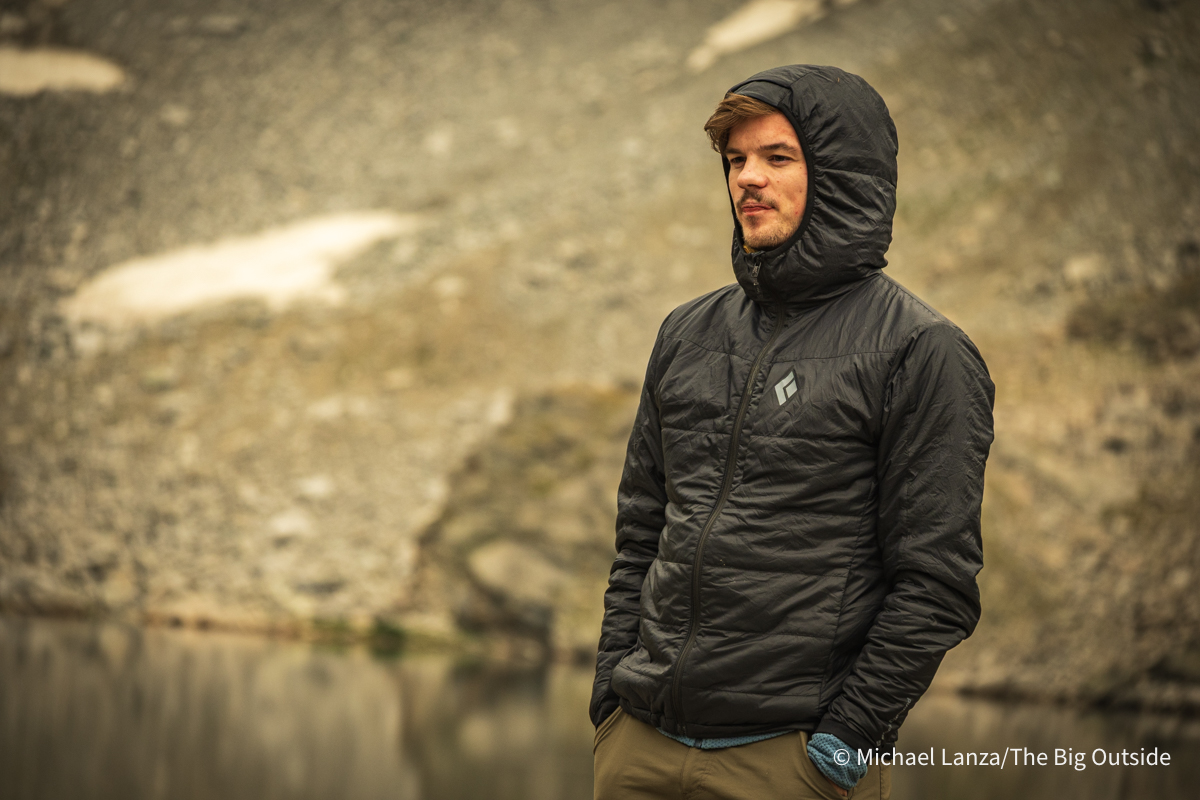
Hooded Insulated Jacket
Black Diamond Solution 2.0 Hoody
$299, 13.8 oz./390g (men’s medium)
Sizes: men’s S-XL, women’s XS-XL
Men’s: blackdiamondequipment.com
Women’s: blackdiamondequipment.com
The Black Diamond Solution 2.0 immediately struck me as a unique layer: at first glance, it’s a puffy, but upon deeper inspection, it’s lighter (in weight and insulation) than many synthetic puffies, and also features windproofness and high water-resistance, giving it features found in shells and insulation layers.
I’ve tested the Solution 2.0 as a midlayer and outer layer resort skiing on windy and wet days of moderate snowfall in spring and as my outer layer in chilly campsites while backpacking in the Wind River Range and elsewhere over the summer with the goal of resolving this dichotomy, and I found myself impressed by its performance—the Solution repels wind and water well and provides good warmth for a synthetic puffy of its weight.
 Hi, I’m Michael Lanza, creator of The Big Outside. Click here to sign up for my FREE email newsletter. Join The Big Outside to get full access to all of my blog’s stories. Click here for my e-books to classic backpacking trips. Click here to learn how I can help you plan your next trip.
The Solution 2.0 uses PrimaLoft Gold with Cross Core insulation; this provides the best warmth-to-weight ratio of any synthetic insulation on the market, according to BD and Primaloft (and it’s certainly used by other brands in their topline synthetic puffy jackets), making the Solution impressively warm for a middleweight puffy (although down insulation rated 800-fill and higher still provides more warmth per weight than even the best synthetic fibers).
The major advantage of synthetic insulation is water resistance, and the Solution exemplifies that: When I took it skiing on a day with wet snowfall and even some rain, it remained warm after getting moderately wet (though I put a shell on over it after a few runs, as it’s not a waterproof layer and will soak through eventually).
Find your next adventure in your Inbox. Sign up now for my FREE email newsletter.
The Solution’s polyester shell with PFAS-free DWR (durable, water-resistant finish) further enhances its water resistance; moderate precipitation beads easily and rolls off the exterior (though it’s not a rain shell; soaking rain gets through the shell to the insulation). I also found that the Solution 2.0 easily blocks wind gusts up to about 30 mph with no noticeable wind chill effect. (In more extreme conditions, I habitually reach for a proper shell, but I wouldn’t be surprised to see the Solution block even stronger wind.)
The Solution 2.0 rounds out with a nice set of features generally found in insulated jackets in this price range: a cordlock adjustable hem to keep out wind and water, two zippered hand pockets and a zippered chest pocket, an adjustable hood large enough to fit over a helmet; and it stuffs into its own left hand pocket, packing down to roughly football-sized. I found the hood hugged my head well and didn’t impair my peripheral vision, and the pockets fit as much as the average for a technical jacket. The elasticized cuffs are not adjustable, so they do allow some precipitation and wind through when conditions veer towards extreme—but at that point, I’m putting a shell on anyway.

From a durability perspective, the Solution resembles many lightweight insulated jackets. The 20-denier nylon shell and lining are tough enough to survive scrapes with branches while hiking, but I wouldn’t want to do any chimney climbing in this. The hardware—zippers and tighteners—all seems standard and durable enough, and I haven’t had any issues, but I’ll report back here if I do.
Since BD markets the Solution 2.0 as a midlayer, breathability is a concern—I usually use midlayers to add warmth while still moving and sweating in cold conditions. And here, I don’t think the Solution measures up to fleece midlayers or air-permeable wind shells (which cut wind but still allow a small amount of flow for convective exchange of moisture vapor) in terms of its ability to ventilate perspiration. While the Solution’s materials are entirely synthetic and repellent to water (meaning sweat vapor will pass through instead of getting soaked up), and it does have some airflow through both the inner and outer layers of material, a much more-breathable fleece or single-layer shell will have better airflow and ventilation (the tradeoff being that fleeces aren’t windproof or as water-resistant and shells don’t provide insulation; the right fleece-shell combo might net you the same warmth with better ventilation if you want to deal with the hassle of multiple layers).
I’ve helped many readers plan unforgettable backpacking and hiking trips.
Want my help with yours? Click here now.
Given its warmth and relative lack of breathability, I can’t see myself moving uphill in the Solution unless it’s windy, not too wet, and very cold out (ie cloudy and below 10F—keep in mind that temperature-wise, I run slightly on the cold side for a mid-twenties man). However, I think the warmth that would keep me from wearing the Solution except in the coldest conditions I encounter in winter makes this layer ideal for women or men who run cold and ski tour/hike uphill with a puffy jacket on in cold weather, which certainly describes many of the gals and some of the guys that I ski tour with—and I would recommend this layer to them.
The combination of windproofness and solid water resistance makes this an ideal layer in any situation where you need a lot of warmth while moving—whether that’s because you run cold, or because the weather just is cold.
I also found the Solution 2.0 great for camping in mild temps, where a high-fill down puffy of the same weight might be too warm (and would be more expensive), and the windproofness nicely cuts moderate to sustained breezes. That said, if you’re looking for more warmth for the same weight (or the same warmth in a lighter jacket), don’t need the water resistance, and have some extra cash to spend, a down puffy will provide a better warmth-to-weight ratio for camping.
Also, Michael Lanza has worn BD’s Solution 2.0 Vest for cool-weather hiking and found the same performance that Nate reports about the hoody.
Let The Big Outside help you find the best adventures.
Join now for full access to ALL stories and get a free e-book!
The Verdict
The Black Diamond Solution 2.0 Hoody provides windproofness and strong water resistance in a fully featured jacket that’s warm enough for camping in cool but not cold conditions—and for certain users, great as a single layer for moving uphill in cold temperatures.
BUY IT NOW
You can support our work on this blog, at no cost to you, by clicking any of these affiliate links to purchase a men’s Black Diamond Solution 2.0 Hoody at blackdiamondequipment.com, a women’s at blackdiamondequipment.com, or any version of the Solution (including hoody, jacket, and vest) at blackdiamondequipment.com, backcountry.com, or rei.com.
See all reviews of outdoor apparel at The Big Outside, including “The 12 Best Down Jackets,” “The Best Base Layers, Shorts, and Socks for Hiking and Trail Running,” “The Best Rain Jackets for Hiking and Backpacking,” and “The Best Ultralight Hiking and Running Jackets.”
—Nate Lanza
Note from Michael Lanza: An avid backpacker, dayhiker, backcountry and resort skier, climber, and trail runner—and my son—Nate Lanza has spent an inordinate amount of time outdoors since he was a preschooler and has two decades of experience on wilderness adventures. He is The Big Outside’s managing editor, writing stories about trips, reviewing gear, and continuing to spend as much time in the backcountry as he can.
At The Big Outside, we review only what we consider the best outdoor gear and apparel. See The Big Outside’s Gear Reviews page for categorized menus of all gear reviews and expert buying tips.