Backpack
Gregory Paragon 60
$300, 60L/3,661 c.i., 3 lb. 10 oz./1.65kg (men’s SM/MD)
Sizes: men’s Paragon SM/MD and MD/LG, women’s Maven XS/SM and SM/MD
Women’s Maven 58: backcountry.com
Men’s Paragon 60: backcountry.com
This fall, I spent five weeks living out of a backpack in Europe, including a five-day hut trek through the Carnic Alps and countless hours hauling gear through train stations and across cities. For this job, I needed a pack that could remain comfortable and organized while carrying a substantial amount of weight. I chose the Gregory Paragon 60, having been impressed by it during its 45-mile maiden voyage in Wyoming’s Wind River Range, and it provided the perfect home-away-from-home for my possessions for the whole trip.
The centerpiece of the trip was our family’s trek of the Carnic Peace Trail, which follows a rough ridgeline on the Austrian-Italian border, but I also had four other weeks of various mountain and urban activities to consider while packing. As a result, I ended up with an absolute pig of a pack—somewhere slightly over 50 pounds after adding food and water for the trek—and the Paragon carried the weight resolutely: The perimeter alloy frame with fiberglass cross-stay prevented any barreling or folding of the pack under this heavy load. I actually found this pack to offer some of the best heavyweight comfort I’ve worn, with my back not substantially bothered by about 50 pounds—though I’m 26, exercise a lot, and weigh 180 pounds, and many users would find a lower maximum comfortable weight.
 Hi, I’m Michael Lanza, creator of The Big Outside. Click here to sign up for my FREE email newsletter. Join The Big Outside to get full access to all of my blog’s stories. Click here for my e-books to classic backpacking trips. Click here to learn how I can help you plan your next trip.
Fit and Comfort
The most important characteristic of the Paragon’s plushness under high load is its stability. The Carnic Peace Trail follows a steep and rugged trail for dozens of miles, including 45-plus-degree sections utilizing cables and incredibly exposed (and spectacular!) ridgelines where a misstep could be fatal. In such terrain, a stable pack is essential, and the Paragon felt glued to my back with no shifting or slipping. Gregory’s suspension system certainly deserves the credit for this: in addition to well-functioning implementations of all the standard fit adjustments (load lifters, adjustable torso length, etc.), the Paragon uses a 90-percent-air AirCushion mesh backpanel that keeps the pack closer to your back than a trampoline-style backpanel while providing almost as much ventilation.

The FreeFloat dynamic hipbelt also contributes substantially by rotating with the wearer’s gait, preventing bounce—I actually jogged a few short distances in the Paragon with no issue. While my 32-inch waist never needed it, the hipbelt also touts a 3D Comfort Cradle: extendable padding on both sides of the hipbelt, secured by a hook-and-loop fastener behind the hipbelt pocket. For those with bigger waistlines, this provides extra cushioning in the front instead of just having the strap digging in.
I found the torso length adjustment to work well, though I ended up at the smallest end of the SM/MD pack I tested (I’m generally a men’s medium shirt, for reference, with smalls fitting me tightly); I think this pack would fit all but the smallest guys, and it seems like there’s plenty of upward adjustment room for those on the boundary between sizes to pick the smaller. (And for guys with unusually short torsos: The fit was still fine when I had the torso adjusted to medium, which is a little too big for me.) The only nitpick I had was that this adjustment—done by breaking a large hook-and-loop seal and sliding the shoulder harness up or down—can get rotationally misaligned in the process (making one shoulder strap higher than the other), though it’s not hard to get it straight again.
Taken together, these features had me feeling stable and in control, with no chafing, over five days with nearly a full third of my body weight on my back.
Like what you’re reading? Sign up now for my FREE email newsletter!


Organization and Externals
Spending five weeks alternating between going out in cities and chasing peaks in the mountains made organization paramount—I was carrying a lot of crap for different activities, and I really didn’t want to go digging through a stuffed 60-liter pack every time I needed something. The Paragon offered a few internal organizational features that really helped me out.
First, the bottom zipper accesses a sleeping bag compartment that can be partitioned from (or integrated with) the rest of the main compartment via an internal divider that detaches on one side. This divider (which has small gaps on three sides; small, loose items could fall into the bottom compartment) did a great job of supporting my large clothes bag, allowing me to store about 10 liters of stuff below where I could get to it easily. The left side of the pack features a zipper which access most of the height of the main compartment: This was useful for items that I deliberately packed on that side, but it doesn’t provide access throughout the pack the way a front or back panel opening does.
The floating lid pocket is voluminous, and its straps have enough slack to keep it from becoming overtight when the pack is completely stuffed—on a few occasions, I even fit a partially loaded daypack under the lid (assisted by the top compression strap, which crosses the pack’s mouth, and can also comfortably retain a baguette, if you’re wondering) when I had plans to go for a dayhike during a travel day. There’s an internal hydration sleeve, but this is the pack’s biggest miss: the SpeedClip hydration hanger is only compatible with Gregory reservoirs, so I couldn’t hang my bladder inside the pack.


Externally, the Paragon also fits plenty. On the left side, a top-access-only mesh pocket (atop the zippered access panel) and two buckled compression straps made it easy to store tall and bulky items; I kept trekking poles and my empty daypack on this side. On the right, two buckle-free compression straps hold items that slide in from above, but much more useful is the mesh pocket on this side, which features angled access (when wearing the pack) augmented by a thumb loop, and is the perfect size for a liter bottle. The thumb loop made it super easy to open the pocket while wearing the pack and slide the bottle in, a task that I’ve more often than not had to ask a partner to do with other packs.
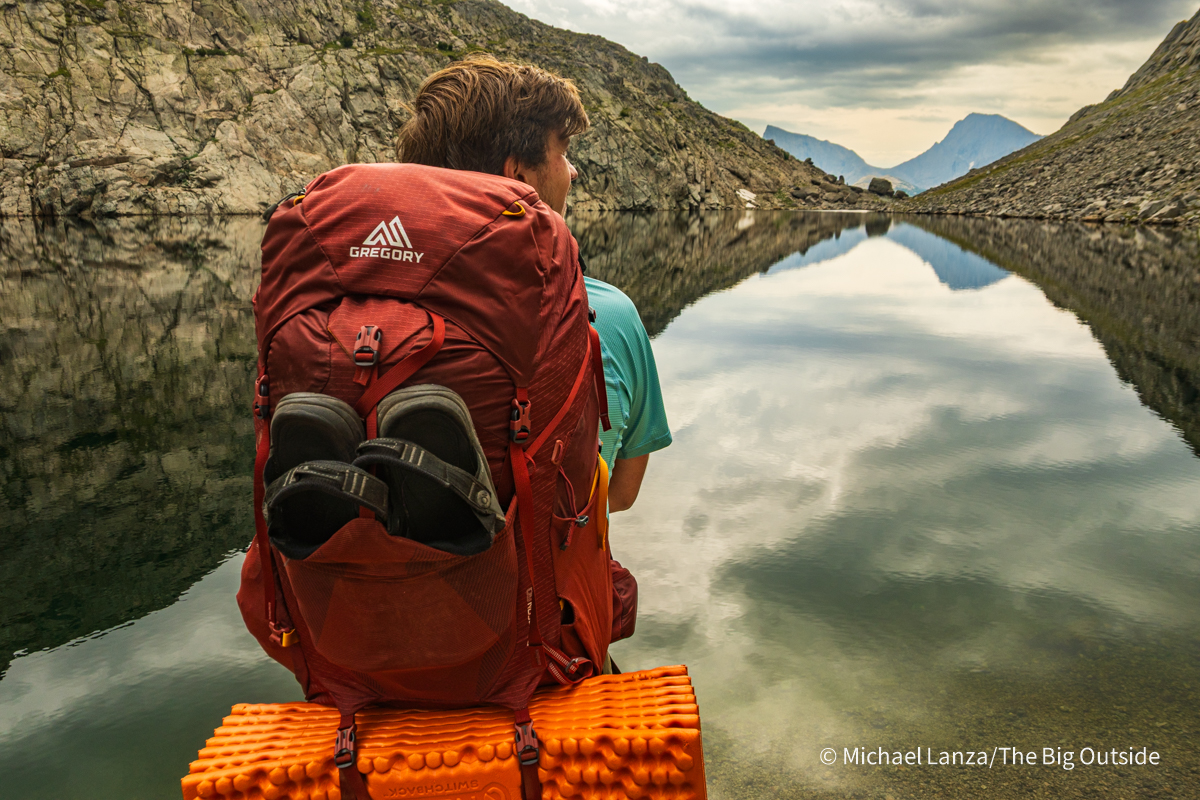
On the front, a large mesh pocket with a top buckle stored my sandals or running shoes; the sandals fit great, but the running shoes fell out a couple of times (though I was able to keep the buckle clipped through the laces to keep myself from losing them). Buckled bottom straps running over the sleeping bag compartment zipper are ideal for a sleeping pad, and I’d be remiss not to mention the hipbelt pockets, which could store three or four energy bars but aren’t close to big enough for my 6.5-by-3-inch phone. Gregory touts the On-The-Go pocket, which lives on the front of the left shoulder strap; while useful for a small item like a Garmin inReach (the device it was designed for), it’s too small to be useful for much. (Pro tip: We’ve heard advice from a friend who leads search-and-rescue teams that they recommend carrying devices like an inReach on your person because victims can get separated from their pack.)
I’ve helped many readers plan unforgettable backpacking and hiking trips.
Want my help with yours? Click here now.

Final Thoughts
The Paragon has a premium feel, and this extends to the details, which include large molded pulls on all zippers, breathable and high-quality foam used throughout the harness, and webbing keepers on the side straps, which helped me pack it for flying. While the pack body isn’t waterproof, it is durable; there are no obvious signs of wear across the entire pack after five continuous weeks of use and a separate backpacking trip.
I think this pack strikes a nice middle ground for many users: It has the size and weight capacity for big trips, but is also light enough to function well for an everyday backpacker: It proved quite comfortable in the Winds, where my dad and I covered 45 miles in only three days, and it compresses well when loaded well under its capacity.
It also comes in 50L and 70L versions (and the women’s Maven comes in 48L, 58L, and 68L), and I think the 50L and 48L versions would be ideal for someone who doesn’t need the extra capacity but still appreciates the comfort and features offered by a midweight pack (as opposed to ultralight options like the Gossamer Gear Gorilla, which generally have far fewer features). For those looking to regularly carry loads around or over 50 pounds, go for the Gregory Baltoro (men’s) or Deva (women’s) instead; they’re designed to carry more at the cost of being heavier themselves.
The Big Outside helps you find the best adventures.
Join now for full access to ALL stories and get a free e-book!
Gregory Paragon 60
The Verdict
The Gregory Paragon 60 offers premium comfort and features at a reasonable weight, and punches slightly above its weight class in terms of carrying capacity. For the backpacker who doesn’t need an ultralight pack and carries loads up to 40 or 50 pounds infrequently, or who doesn’t carry that much but appreciates the extra features of a midweight pack, the Paragon provides a well-designed and attractive option.
BUY IT NOW
You can support our work on this blog, at no cost to you, by clicking any of these affiliate links to purchase a men’s Gregory Paragon 60 at backcountry.com, a women’s Maven 58 at backcountry.com, or any size of the Paragon or Maven at gregory.com, backcountry.com, or rei.com.
See “The 10 Best Backpacking Packs” and “The Best Ultralight Backpacks,” “5 Expert Tips For Buying the Right Backpacking Pack,” and all reviews of backpacks and backpacking gear, ultralight backpacks, and ultralight backpacking gear at The Big Outside.
See also “5 Smart Steps to Lighten Your Backpacking Gear” and our “10 Tips for Spending Less on Hiking and Backpacking Gear,” and all stories with expert backpacking tips at The Big Outside.
—Nate Lanza
Note from Michael Lanza: An avid backpacker, dayhiker, backcountry and resort skier, climber, and trail runner—and my son—Nate Lanza has spent an inordinate amount of time outdoors since he was a preschooler and has two decades of experience on wilderness adventures. He is The Big Outside’s managing editor, writing stories about trips, reviewing gear, and continuing to spend as much time in the backcountry as he can. At The Big Outside, we review only what we consider the best outdoor gear and apparel. See The Big Outside’s Gear Reviews page for categorized menus of all gear reviews and expert buying tips.