By Michael Lanza
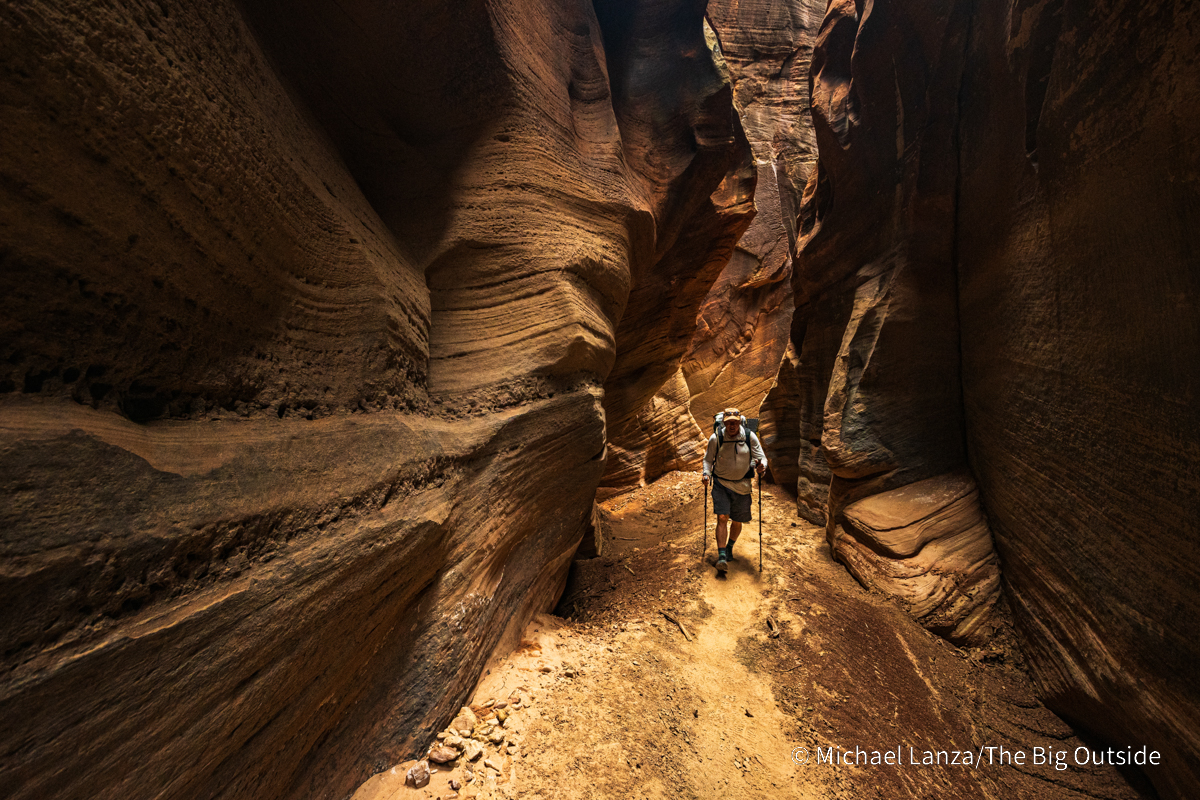
We haven’t hiked far down the sandy wash from the Wire Pass Trailhead when the red rock walls start steadily rising higher on both sides and crowding in closer. And although none of the four of us has backpacked this route into southern Utah’s Buckskin Gulch before, we’re all familiar with approach hikes into slot canyons—and the unnatural and kind of thrilling sensation of descending into the Earth.
Before long, the walls stand barely more than shoulder-width apart and perhaps a hundred feet tall and the light at the bottom of this slot canyon grows dim. We downclimb a sturdy wooden ladder installed for getting over a pour-off that drops several feet. Little or no direct sunlight reaches us now, only the reflected light hitting the tops of these walls and seeping downward. In rare places where the twisting canyon aligns with the sun, the sudden direct sunlight feels intensely hot, especially in contrast to the pleasant coolness of the deep shade filling most of this slot.
 Hi, I’m Michael Lanza, creator of The Big Outside. Click here to sign up for my FREE email newsletter. Join The Big Outside to get full access to all of my blog’s stories. Click here for my e-books to classic backpacking trips. Click here to learn how I can help you plan your next trip.

The flat, dry, sandy bottom initially makes for relatively easy walking. Then we encounter a rockier bottom and the first puddles, some spanning the slot from wall to wall and extending for 10, 20, 30 or more feet, some shallow, others calf deep. Where puddles have dried up, we walk across mud—sometimes firm, sometimes quite mucky. But nothing that compares to my recollection of the first time I backpacked down Buckskin Gulch and we had to wade through thigh-deep pits of watery but thick muck that felt like wet cement choked with sticks and stones, all of which had been smashed up and carried downstream by flash floods.
Less than an hour from the trailhead, we reach this short tributary canyon’s confluence with Buckskin Gulch and turn downstream.
My friends David Gordon, Doug Jenkins, and Jeff Wilhelm and I are backpacking down Buckskin Gulch to the canyon of the Paria River, which flows from southern Utah into northern Arizona and empties into the Colorado River at Lees Ferry, the gateway to the Grand Canyon. Instead of hiking from the Buckskin-Paria confluence all the way down Paria to Lees Ferry, we’re planning to finish at the White House Trailhead, the starting point for the usual route that backpackers follow down Paria Canyon to Lees Ferry.
And we have a weather forecast that has placed a somewhat hard deadline on our backpacking trip—a trip that we’re undertaking, nonetheless, because we’re all experienced enough to share high confidence that we can meet that deadline.
(The Take This Trip section at the bottom of this story includes much more detail about our itinerary, why I originally planned it as I did, and how and why we changed our plans right before the trip based on the weather forecast. Much of this story is free for anyone to read, but reading all of this story, including that Take This Trip section, is an exclusive benefit of a subscription to The Big Outside.)
Find your next adventure in your Inbox. Sign up now for my FREE email newsletter.


One of the Best Backpacking Trips in the Southwest
As we continue down Buckskin Gulch, the walls, often slightly overhanging, rise to perhaps 200 feet high and the canyon widens and narrows a few times. But it mostly remains a true, very narrow slot. Gazing around, I’m reminded that the greatest magic of slot canyons is how the diffused light paints the orange and red walls in too many shades of those colors to quantify, as well as shades of brown and a deep black that looks like an oil spill—creating stark contrasts that delight and mystify the human eye and brain.
Wildly rippled and sculpted by too many floods for us to guesstimate, over too many years for us to fathom, and scored by layers of geology, the tall, sheer walls also preclude any quick escape from this canyon: The only exits lie hours behind or ahead of us. And that is why you only want to hike any slot canyon with a reliable forecast for clear skies and zero rain.
After Buckskin Gulch and Paria Canyon, hike the rest of
“The 12 Best Backpacking Trips in the Southwest.”

For a few decades now, Buckskin Gulch, located in the Paria Canyon-Vermilion Cliffs Wilderness on the Utah-Arizona border, has been increasingly well known as possibly the longest slot canyon in America, and perhaps the world. (The first claim seems substantiated by the lack of another one identified as longer, but the second claim may be unknowable.) The official measure given Buckskin by its management agency, the Bureau of Land Management, puts it at 16 miles from the top of its actual canyon—like many canyons here, it begins as an almost flat, usually dry wash in the open desert, with no walls—to its confluence with Paria Canyon. Type its name into a search engine and the top phrase likely to fill in is “Buckskin Gulch longest slot canyon.”
And Paria Canyon, hiked by itself or in combination with Buckskin, has long been widely considered one of the best backpacking trips in the Southwest—and I would argue one of the top three or five. For the very good reason of protecting the river’s water quality and this fragile canyon environment, the permit system limits the number of backpackers starting a multi-day hike here at a total of 20 people per day. In my experience, because parties spread out in these canyons, that system ensures a nice degree of solitude.
Let The Big Outside help you find the best adventures.
Join now for full access to ALL stories and get a free e-book!


Hiking a slot canyon where heavy rainstorms regularly trigger flash floods that constantly deposit new debris and relocate and reorganize pre-existing debris can feel like investigating the rubble of a city recently bombed—and indeed, the damage from flash floods is often relatively recent, certainly in geological time, having occurred only months or weeks or even just days before.
We occasionally pass below logs that were once tree trunks, stripped of their bark and white as bones, pinned between the walls 20 to 30 or more feet overhead by some past flood, spanning the canyon like little bridges for wall-climbing lizards. The height of those logs speaks to the depth and power of the floodwaters that pinned them—forces that anyone would shudder to contemplate.
I can help you plan this or any trip you read about at my blog. Click here to learn how.

We step around the decaying carcass of an animal, maybe a pronghorn or a goat, that either fell to its death from the canyon rim high overhead or was swept away in a flash flood, carried probably a considerable distance, and deposited there when the water level dropped.
At a jam-up of giant boulders that spans Buckskin’s close walls—looking like some catastrophic geologic train wreck—we scramble over and around gritty, sandy rocks to find a route through the wreckage. We first climb up, then carefully downward through a gap, passing our packs through difficult and tight spots, and finally underneath rocks to reach the jam’s other side. And continue hiking.

Finally, some nine or more hours after we started out from the Wire Pass Trailhead, we find an established, sandy campsite on a bench a few feet above the canyon bottom, in a stretch of lower Buckskin Gulch that widens to at least 200 to 300 feet across. Soaring walls of vermilion, maroon, and scarlet with dark water streaks rise at least a couple hundred feet above us, riddled with ledges, cracks, overhangs. Smallish cottonwood trees inhabit the benches of sand and mud on both sides of this bend in the canyon.
We drop our packs and pitch tents, all of us genuinely surprised at how long and hard a day we just had—our fatigue considerably amplified by the several liters of water we each carried, not sure whether we’d find any in Buckskin or how silted it might be, and the same with the Paria River tomorrow. One party of three is camped a short distance from us, out of sight and mostly beyond earshot. Before dark, a lone backpacker claims the campsite directly across the canyon from us.
The spring desert night seems to drip very slowly from the sky because of the protracted time between when the sun drops behind the walls in late afternoon and when darkness overtakes the canyon later in the evening. Dusk takes its sweet time in the bottom of a narrow canyon.
And the absolute silence on a windless evening like this one feels as dense as the quicksand that I’ve encountered on both of my previous trips into these canyons. Words spoken somewhat loudly echo distinctly off the walls, sounding like they were mimicked perfectly by another person just across the canyon.
Join now to read all of this story, including my expert tips on planning this trip,
and ALL stories at The Big Outside, plus get a FREE e-book!


Paria Canyon
At the Buckskin Gulch-Paria Canyon confluence the next morning, I look around, searching, I guess, for something about this spot that looks familiar. But nothing does. That’s the nature of Southwest canyons—nothing remains the same for very long. I can’t imagine how many flash floods have rearranged Buckskin and Paria over the past three decades since I first stood here.
I last stood at this confluence 10 years ago, on a backpacking trip with my family and another family, our group including four teenagers and one ’tweener; we started at White House Trailhead, instead of the Wire Pass Trailhead, and hiked down Paria to Lees Ferry, not attempting Buckskin that time because of reports of about four feet of icy water filling that canyon on that late-March trip. (We ran into a couple at a campsite in lower Paria Canyon who told us they had backpacked down Buckskin, wading for hours through icy water with their puffy jackets and every layer they brought on their upper bodies—and were still freezing.)
Click here now to plan your next great backpacking adventure using my expert e-books.

And before that, I stood at this confluence 32 years ago, with my girlfriend (now my wife) after camping the night before somewhere very close to where we camped last night, possibly on the same sandy bench—although, undoubtedly, the canyon bottom has been reshaped countless times since then and would look different today from that first trip, while the upper walls may remain largely unchanged.
Find the best gear, expert buying tips, and best-in-category reviews at my Gear Reviews page.
See also my stories “The Quicksand Chronicles: Backpacking Paria Canyon,” “The 12 Best Backpacking Trips in the Southwest,” and all stories about hiking and backpacking in southern Utah at The Big Outside.
The Gear I Used See my reviews of the outstanding backpack, ultralight backpacking tent, ultralight sleeping bag, ultralight air mattress, and stove I used on this trip.
Want my help planning the details of this trip, including an itinerary appropriate for your group? See my Custom Trip Planning page to learn how I can help you plan this or any trip you read about at this blog.
Your Quicksand Chronicles inspired our trip! Four years ago I dayhiked in from White House and immediately knew I had to do the full route. This October, I returned with my adult daughters for the complete thru-hike four years to the day from that first visit. We had the canyon practically to ourselves, navigated plenty of mud and flash-flood conditions, and created memories that’ll last a lifetime. Thanks for the inspiration to make it happen.
Thanks for sharing that story, Kevin, and good to hear from you again. I’m sure you and your daughters had an amazing adventure in Paria, especially having it almost to yourselves. Great memories! Well done. Thanks also for being a subscriber to The Big Outside, I appreciate your support for my blog.